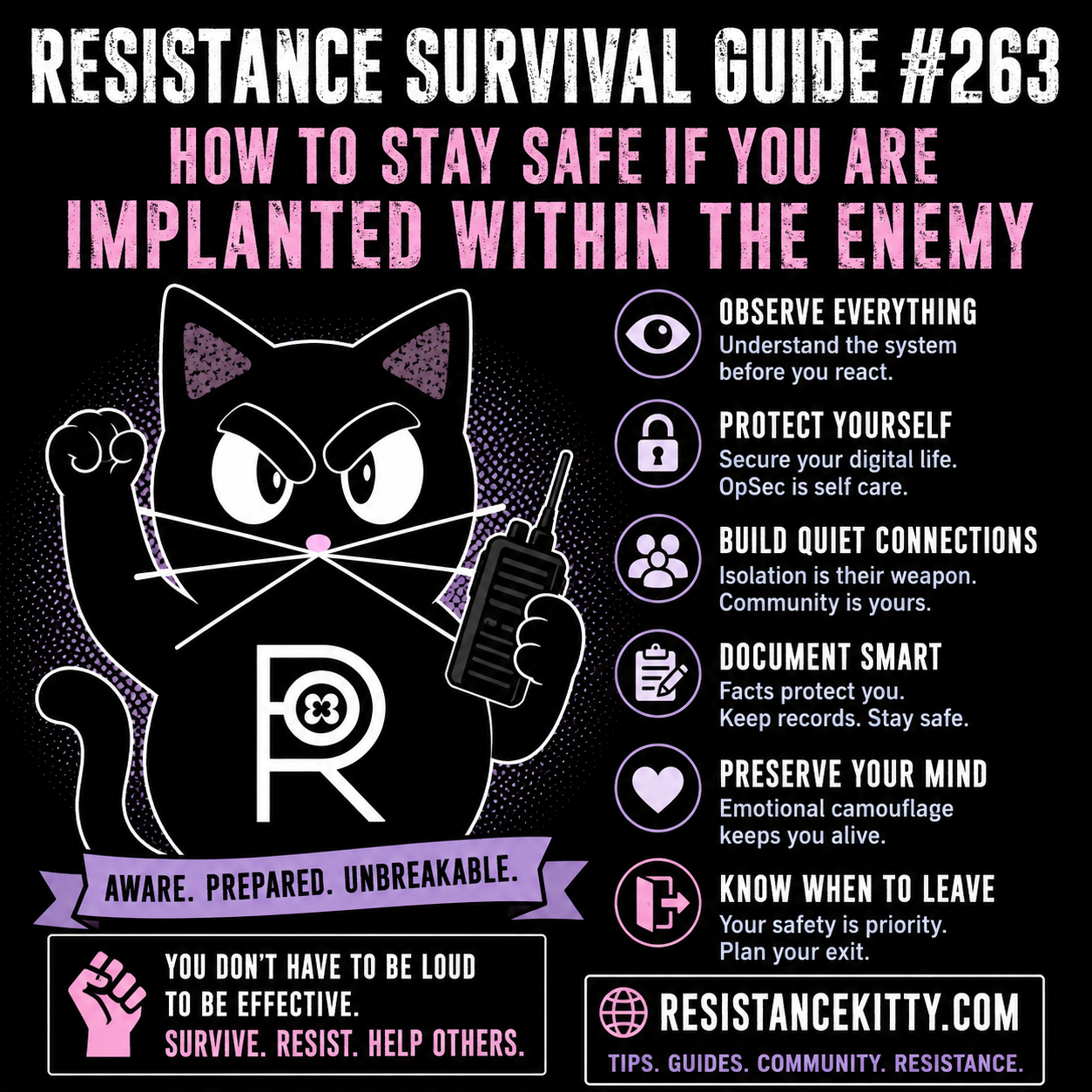
When authoritarians invoke martial law, the goal is not order — it’s control through fear and confusion. Curfews, checkpoints, military patrols, and mass surveillance are meant to make people panic or comply blindly. Today’s Resistance Survival Guide focuses on the most radical act in an emergency state: staying safe, staying grounded, and staying alive. Preparation is not paranoia. It is how communities endure long enough to outlast power grabs.
Skill Level: Advanced — Civic Defense & Personal Safety
What This Tool Is
This guide is a practical safety framework for civilians if martial law is declared or functionally imposed. Martial law expands military authority, restricts movement and assembly, and increases surveillance and detention risks. This tool focuses on risk reduction, situational awareness, and survival rather than confrontation.
Why This Tool Is Important
The earliest phase of martial law is the most dangerous. Rules change rapidly, enforcement is inconsistent, and fear leads people to make risky decisions. People are detained or harmed not because they resist, but because they are unprepared. Staying safe preserves individuals, protects communities, and sustains long-term resistance.
Step-by-Step: How to Stay Safe Under Martial Law
Step 1: Prioritize Personal Safety Over Visibility
Your first responsibility is to remain alive and free.
• Follow curfews exactly
• Avoid checkpoints whenever possible
• Limit time in public spaces
• Do not carry protest signs, gear, or political materials
• Dress neutral and blend in
If stopped, speak only as legally required. Do not volunteer information.
Step 2: Lock Down Your Digital Life
Emergency powers almost always increase surveillance.
• Disable Face ID and fingerprint unlock
• Use a strong passcode
• Turn off location sharing
• Log out of activist accounts
• Back up important data and remove sensitive files
Assume your phone may be searched or seized.
Step 3: Prepare Your Home for Restricted Movement
You may need to shelter in place with little notice.
• Store 3–7 days of food and water
• Refill prescriptions early if possible
• Charge power banks and devices
• Keep essential documents accessible
• Keep shoes, ID, and a jacket ready
If authorities knock, you generally do not need to open the door without a warrant. Communicate through the door if necessary.
Step 4: Know and Use Your Legal Rights
Rights may be limited, but they do not disappear.
• Ask “Am I being detained?”
• If yes, state “I want a lawyer.”
• If no, ask “Am I free to go?”
• Do not consent to searches
• Do not sign anything without legal counsel
Write down a legal aid number. Do not rely solely on your phone.
Step 5: Protect Vulnerable People Quietly
Martial law impacts marginalized communities first and hardest.
Check in on
• Immigrants
• Trans and queer people
• Disabled neighbors
• Elders
• Unhoused community members
Mutual aid should be discreet, coordinated, and low-visibility.
Step 6: Document Only When It Is Safe
Evidence matters, but safety matters more.
• Avoid filming openly at checkpoints or patrols
• Upload footage immediately to secure storage
• Remove metadata when possible
• Never keep sensitive footage on your device
No recording is worth detention or injury.
Step 7: Reduce Exposure and Tighten Trust
This is not the time for open networks.
• Shrink communication circles
• Avoid large group chats
• Verify information before sharing
• Expect misinformation and provocations
Silence can be a form of protection.
Emergency Go-Quiet Checklist
Use this if conditions escalate rapidly.
• Phone secured
• ID only, nothing extra
• Home stocked
• Legal number written down
• Trusted contact notified
• Social media paused
Preparation is not panic. It is control.
Absolutely. Here is a clean, template-compatible section you can drop directly into the guide. No separators, just a heading and short annotations so readers know why each link matters.
Resources to Read and Save
These materials explain what martial law is, how emergency powers are used in the U.S., and what rights still apply during periods of civil and military enforcement. Bookmark or download what you can in advance.
Martial Law, Explained — Brennan Center for Justice
A clear, plain-English breakdown of what martial law is, how it differs from emergency powers, and the constitutional limits on its use.
https://www.brennancenter.org/our-work/research-reports/martial-law-explained
Insurrection Act of 1807 — Overview
Explains the federal law most often cited alongside martial law and how presidents can deploy military forces domestically.
https://en.wikipedia.org/wiki/Insurrection_Act_of_1807
Know Your Rights: Encounters with Law Enforcement or Military — ACLU
Practical guidance on what to say, what not to say, and how to protect yourself during stops, searches, curfews, or checkpoints.
https://www.aclu.org/know-your-rights
Civil Rights and Civil Liberties in Emergencies — Department of Homeland Security
Outlines how civil rights are supposed to be protected during declared emergencies, disasters, and security operations.
https://www.dhs.gov/civil-rights-emergencies-and-disasters
Personal Emergency Preparedness Planning — U.S. State Department
Step-by-step guidance for preparing for disruptions to travel, communications, and daily life during emergencies.
https://www.state.gov/personal-preparedness-planning
Civil Unrest Guidance — EMS.gov
Focuses on personal decision-making, situational awareness, and safety during periods of widespread civil disruption.
https://www.ems.gov/assets/Guidance_Resources_Civil_Unrest.pdf
Developing Emergency Operations Plans — FEMA
A comprehensive preparedness guide that explains how emergencies unfold and how individuals and communities can plan ahead.
https://www.fema.gov/sites/default/files/2020-05/CPG_101_V2_30NOV2010_FINAL_508.pdf
Final Word from Resistance Kitty 🐾
Martial law depends on fear, chaos, and impulsive courage. Real resistance is discipline, patience, and survival. Staying safe is not compliance. It is strategy.
Martial law thrives on chaos and spectacle. Resistance survives through discipline, patience, and people who know when to move and when to stay still. You do not owe anyone your fear or your body. Staying safe is not giving up — it is choosing to be here tomorrow, when accountability comes due and rebuilding begins.