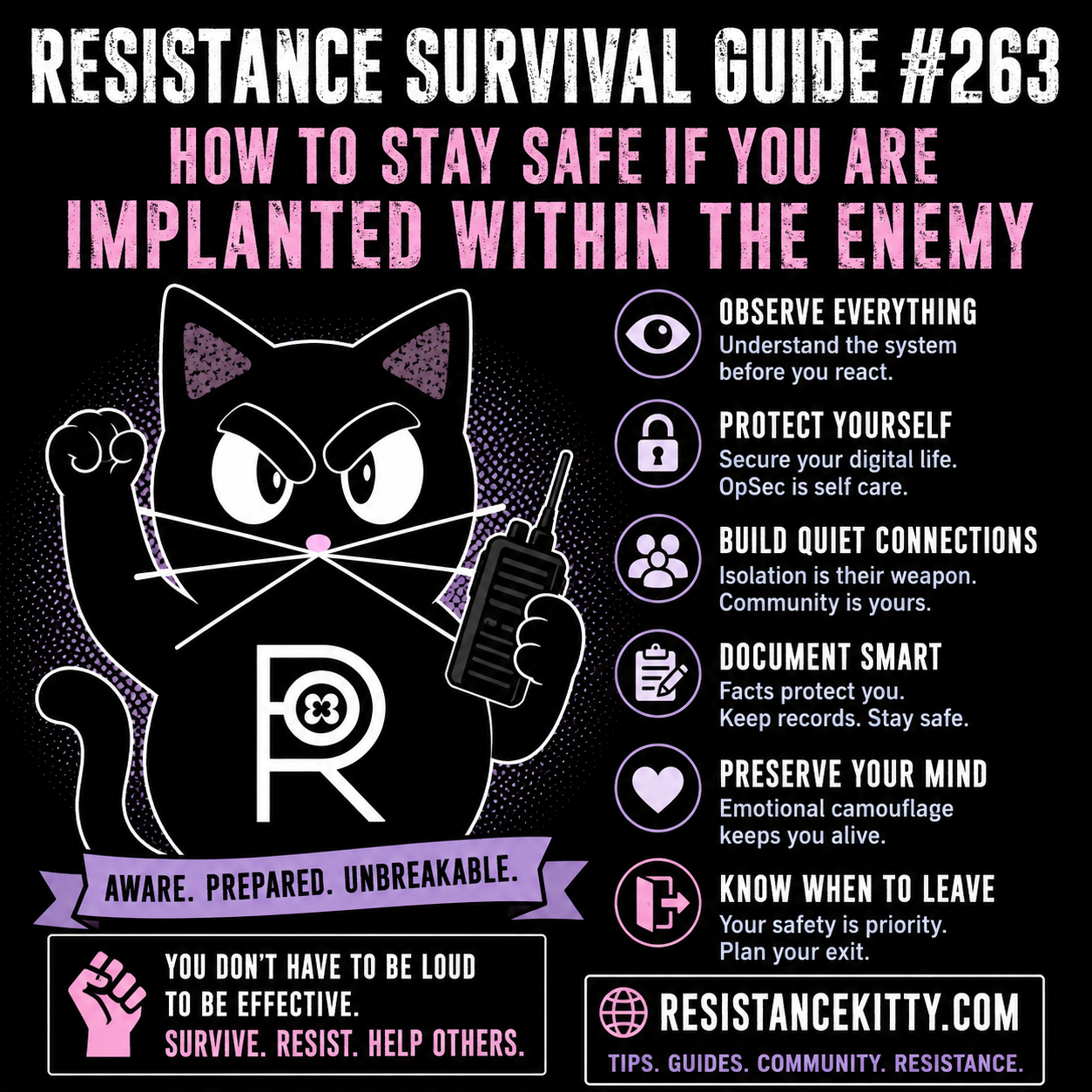

Resistance Survival Guide #263
Skill Level: Advanced
Why This Matters
A lot of people think resistance only looks like marches, signs, or public organizing. Sometimes resistance looks quieter. Sometimes it looks like surviving inside a hostile workplace, extremist family structure, political organization, abusive institution, or propaganda ecosystem without losing yourself in the process. History is full of people who gathered information, protected vulnerable people, documented abuse, slowed harmful systems from the inside, or quietly helped others escape dangerous environments.
This guide is not about illegal activity or reckless infiltration fantasies. It is about emotional survival, operational awareness, digital safety, and personal protection when you are surrounded by manipulative people, authoritarian culture, extremist rhetoric, or systems that punish dissent. If you are inside an environment that pressures loyalty, punishes independent thinking, or rewards cruelty, your first responsibility is staying safe and mentally intact.
Learning how to move carefully inside hostile environments matters because propaganda systems thrive on fear, isolation, and exhaustion. The moment you lose perspective or become emotionally reactive, those systems gain leverage over you. The goal is survival, clarity, documentation, and protecting yourself while minimizing harm.
What This Is
Being “implanted within the enemy” does not mean pretending to be a spy in an action movie. In real life, it often means existing inside spaces where you do not fully agree with the ideology or behavior around you. That could mean working inside a hostile political environment, being stuck in a family system shaped by extremism, surviving inside a toxic workplace, or existing inside institutions where speaking openly could put your safety, housing, employment, or stability at risk.
The most important thing to understand is this. Your safety matters more than proving a point. Many people destroy themselves trying to win arguments, expose everything immediately, or emotionally confront dangerous people before they are prepared. Sustainable resistance requires patience, emotional discipline, strong boundaries, and careful information management.
Organizations like the independent journalism outlet Bellingcat and the digital security experts at Electronic Frontier Foundation have repeatedly emphasized that documentation, situational awareness, and operational security are more effective than impulsive confrontation. People survive dangerous systems by staying grounded, informed, connected, and cautious.
Step by Step Guide
Step 1 Understand The Environment Before You React
The first thing you should do inside any hostile environment is observe patterns before taking action. People often reveal power structures very quickly if you pay attention. Watch who gets punished. Watch who gets protected. Watch how information spreads. Watch which topics create fear or silence.
Authoritarian environments usually operate through emotional conditioning rather than direct force alone. You may notice pressure to conform, group humiliation rituals, aggressive loyalty testing, gossip networks, fear based messaging, or attempts to isolate people from outside perspectives. Researchers at the independent nonprofit The Center for Countering Digital Hate have written extensively about how manipulation systems reinforce identity and loyalty through repetition and fear.
Instead of immediately challenging everything around you, focus on understanding how the system maintains control. Knowledge reduces panic. Panic makes people vulnerable.
Step 2 Protect Your Digital Footprint
If you are inside a hostile environment, digital safety matters immediately. Never assume private conversations are truly private. Do not overshare your political views, organizing work, passwords, personal schedules, or activism plans with people you do not fully trust.
Start by strengthening your personal security habits. Use strong passwords and enable multifactor authentication. The nonprofit newsroom Freedom of the Press Foundation provides excellent digital safety guides for activists, journalists, and whistleblowers. Privacy focused tools like Signal are safer than ordinary text messaging for sensitive communication because messages are encrypted.
You should also separate identities when possible. Keep activism accounts separate from personal accounts. Avoid posting real time locations publicly. Be cautious about shared photos, metadata, workplace identifiers, and private group screenshots. Many hostile groups monitor social media carefully looking for leverage or contradictions.
The goal is not paranoia. The goal is reducing unnecessary exposure.
Step 3 Build Quiet Outside Connections
Isolation is one of the most dangerous parts of surviving inside manipulative systems. People lose perspective when every voice around them reinforces the same ideology, fear, or emotional pressure. You need trusted outside contact with grounded people who can help you reality check situations.
That does not mean telling everyone everything. It means intentionally maintaining contact with safe people outside the hostile environment. Independent media communities, mutual aid groups, local support organizations, and trusted friends can help prevent psychological isolation.
Projects like Right To Be and community support networks listed through Mutual Aid Hub offer resources on de escalation, emotional support, and community safety. Quiet connection matters because manipulative systems become much harder to resist when they convince people they are completely alone.
Step 4 Document Carefully And Responsibly
Documentation can protect you later if situations escalate. Keep organized records of concerning incidents, threats, harassment, policy changes, or dangerous behavior. Store records securely and privately. Documentation is especially important in workplaces or institutions where retaliation may occur.
That said, you should never document recklessly. Do not illegally record conversations where prohibited by law. Do not store sensitive information on employer devices. Do not expose vulnerable people accidentally. Responsible documentation means balancing evidence collection with personal safety.
Investigative organizations like ProPublica regularly demonstrate how careful records and timelines become critical when exposing abuse, corruption, or systemic wrongdoing. Small details matter over time.
Keep emotional notes separate from factual notes. Dates, times, screenshots, public statements, policy memos, and direct quotes are more useful than emotional summaries.
Step 5 Learn Emotional Camouflage
One of the hardest survival skills inside hostile systems is learning how to avoid unnecessary escalation. Emotional camouflage does not mean abandoning your values. It means choosing when and how to respond strategically.
You do not have to debate every conspiracy theory. You do not have to correct every manipulative comment in real time. In some environments, visibly resisting every moment simply paints a target on you while accomplishing nothing.
Psychologists studying coercive environments have long observed that people survive high pressure systems by preserving internal clarity while avoiding performative confrontation. The independent publication Greater Good Magazine has published useful research on emotional regulation, conflict management, and psychological resilience during high stress situations.
Sometimes survival means staying calm while gathering information, building support quietly, and waiting for safer opportunities to act.
Step 6 Know When To Leave
Not every environment can be changed from within. Some systems are simply dangerous. If you are facing escalating threats, stalking, abuse, violence, coercion, or severe psychological harm, your priority should become exit planning rather than endurance.
Leaving safely often requires preparation. Build financial stability if possible. Protect copies of important documents. Strengthen outside relationships. Identify emergency housing or support resources ahead of time. Organizations like the National Domestic Violence Hotline provide planning tools that are useful not only for abusive relationships but also for coercive control environments more broadly.
You do not owe dangerous people unlimited access to your mind or body. Survival is not weakness. Leaving is not failure.
Example
Imagine someone working inside a workplace where extremist rhetoric, harassment, and intimidation are becoming normalized. Instead of publicly exploding during every meeting, they quietly begin documenting policy changes, securing personal communications, strengthening outside friendships, attending local mutual aid meetings, and researching employment protections. Over time, they safely connect with others who share concerns. Eventually, they leave with records intact, emotional support established, and enough clarity to protect themselves without spiraling into isolation or retaliation.
That approach may look less dramatic than movie style resistance, but it is often far more effective in real life.
Required Reading
- Electronic Frontier Foundation Security Guides
- Freedom of the Press Foundation Digital Safety Training
- Bellingcat Online Investigation Toolkit
- Right To Be De Escalation Resources
- Mutual Aid Hub Community Networks
- Greater Good Magazine Conflict And Resilience Articles
- ProPublica Investigations
- National Domestic Violence Hotline Safety Planning Resources
Conclusion
Authoritarian systems want people exhausted, isolated, impulsive, and afraid. Staying safe inside hostile environments requires the opposite. You need patience, awareness, emotional discipline, outside support, and realistic planning. Real resistance is often quieter than people imagine. It looks like protecting your mind while refusing to surrender your values.
You do not need to become reckless to resist manipulation. You do not need to martyr yourself to matter. The people who survive long enough to help others are usually the ones who learned how to stay grounded while dangerous systems tried to pull them apart.
Kitty’s Resistance Projects
- Resistance Directory:https://resistancedirectory.com/
- EpsteinWiki:Epsteinwiki.com
Support Resistance Kitty’s Work
- Kitty Merch:https://rgearshop.com/
- Support Kitty:https://buymeacoffee.com/resistancekitty