
Resistance Survival Guide #265
Skill Level: Intermediate
The modern surveillance state does not just rely on cameras and police databases anymore. It relies on carelessness. Most people store sensitive information in predictable places, reuse the same passwords, trust giant cloud companies with everything, and leave massive digital trails without realizing it. Journalists, organizers, researchers, and whistleblowers learned long ago that protecting information is not paranoia. It is basic survival.
A digital dead drop system is simply a secure way to store or transfer information without exposing your entire identity, network, or device ecosystem. Think of it like creating hidden emergency exits for your data. If one account gets compromised, the rest stays protected. If one device fails, your information survives. If one platform disappears overnight, you still control your files and communications.
The good news is that you do not need spy movie gadgets or a computer science degree to build a practical operational security system. You just need discipline, compartmentalization, and the willingness to stop handing your entire digital life to corporations that monetize your data.
Why This Matters
Activists, investigative journalists, mutual aid organizers, and vulnerable communities are increasingly targeted through hacked accounts, leaked messages, metadata tracking, phishing attacks, and platform monitoring. Sometimes the threat comes from governments. Sometimes it comes from extremists. Sometimes it comes from corporations harvesting behavioral data. Sometimes it comes from stalkers, abusive partners, or random opportunists.
A personal digital dead drop system helps reduce catastrophic failure. It gives you layers. If one layer breaks, everything else does not collapse with it.
This is especially important during protests, political unrest, whistleblower activity, labor organizing, immigration advocacy, reproductive rights work, and independent journalism. Information security is no longer optional for public facing organizers.
What This Is
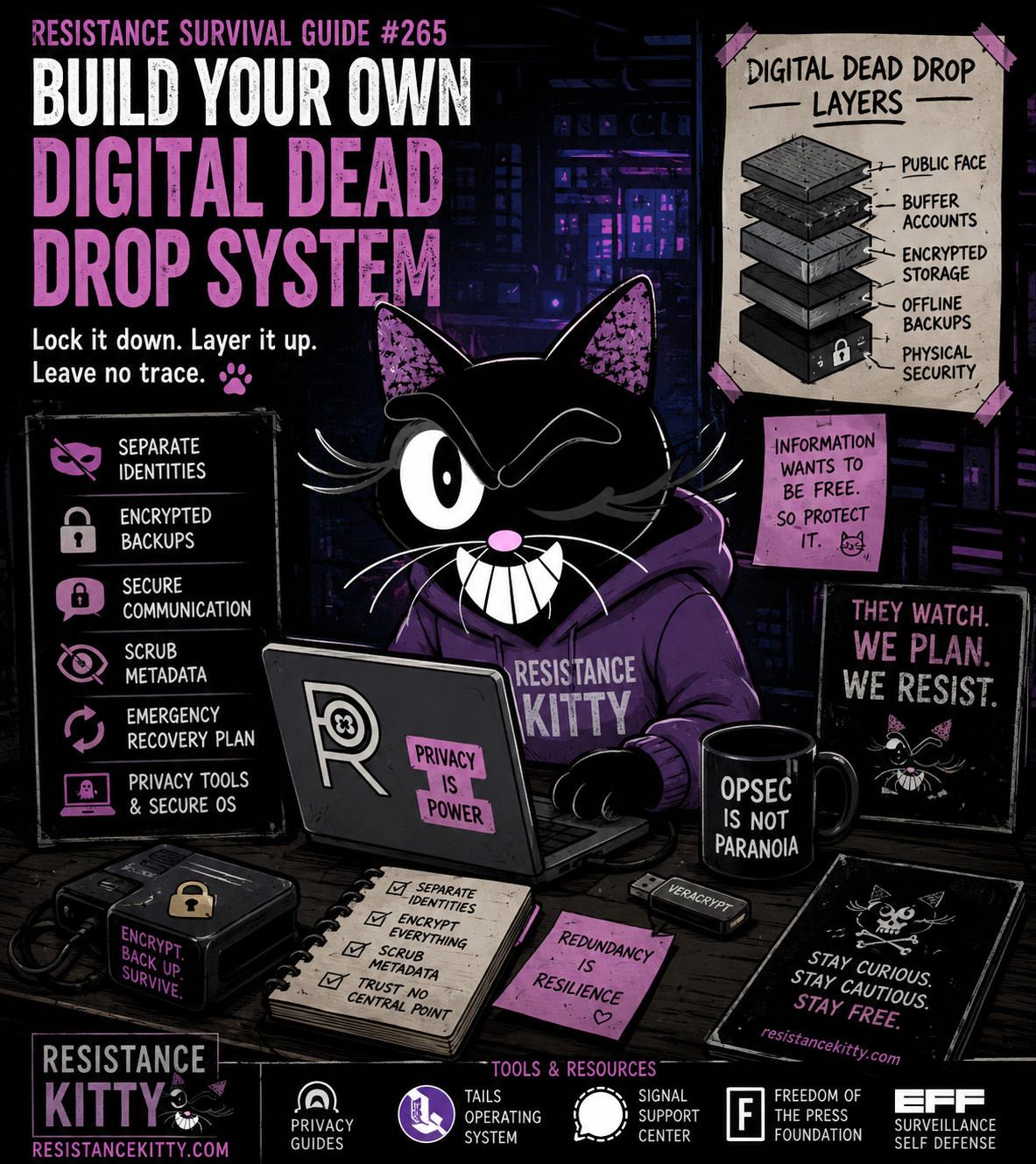
A digital dead drop system is a combination of encrypted storage, compartmentalized accounts, offline backups, secure communication methods, and emergency recovery plans. The goal is simple. Keep sensitive information accessible to trusted people while making it difficult for hostile actors to intercept, destroy, or expose it.
Real operational security is usually boring. It is not dramatic hacking scenes from television. It is careful habits repeated consistently over time.
Step by Step Guide
Step 1: Separate Your Identities and Devices
The first step is learning compartmentalization. Do not run activism, personal life, professional work, and sensitive research from the exact same accounts and devices whenever possible.
Many investigators maintain separate browser profiles, email addresses, and even dedicated devices for sensitive work. This limits damage if one account is compromised. A phishing attack against your public email should not automatically expose your research archives, encrypted backups, or private contacts.
A simple starting point is creating a separate browser profile specifically for sensitive activity. Use different passwords, different recovery emails, and different login habits. Avoid linking everything to the same phone number whenever possible.
The operational security guides from Privacy Guides explain compartmentalization strategies in beginner friendly language.
Step 2: Build Encrypted Offline Backups
Cloud storage is convenient until an account gets locked, hacked, subpoenaed, or deleted. Important files should exist in at least three locations. One active copy, one encrypted offline copy, and one secondary backup stored separately.
Encrypted USB drives are one of the simplest solutions. Sensitive files can be stored inside encrypted archives using tools like VeraCrypt or Cryptomator. Store copies in physically separate locations when possible.
This matters because ransomware attacks, device theft, political targeting, and accidental deletion happen constantly. Offline backups cannot be remotely erased if they are disconnected.
The encryption guides from Privacy Guides Encryption Tools Guide provide practical walkthroughs for beginners.
Step 3: Use Secure Communication Channels
A dead drop system is not just about storage. It is also about communication. Sensitive information should not move through insecure channels.
Avoid sending critical documents through ordinary text messaging or social media direct messages. Metadata alone can reveal a surprising amount about relationships and networks.
Apps like Signal Support Center explain how end to end encrypted communication works and how disappearing messages reduce long term exposure. Signal is not magic invisibility armor, but it is dramatically safer than standard SMS messaging.
For highly sensitive situations, consider delaying communications, using temporary accounts, or sharing encrypted files separately from passwords. Never place the password and encrypted archive in the same message thread.
Step 4: Learn How Metadata Betrays People
One of the biggest mistakes beginners make is focusing only on file contents while ignoring metadata. Photos, PDFs, and documents often contain hidden information like GPS coordinates, usernames, device details, timestamps, and editing history.
Before sharing sensitive files, scrub metadata whenever possible. Tools like MAT2 on Linux or metadata removal functions built into privacy focused systems can help reduce exposure.
Journalists and investigators frequently use the security training materials from Freedom of the Press Foundation Security Training because they explain real world risks instead of fantasy scenarios.
Metadata has exposed protest locations, source identities, military positions, and anonymous researchers. Small details matter.
Step 5: Create an Emergency Recovery Plan
Most people spend time thinking about how to hide information but never think about what happens if they lose access themselves.
Create a secure recovery plan. This can include printed recovery codes stored in a safe place, encrypted password manager exports, trusted emergency contacts, or sealed instructions for critical information.
If you disappear from the internet tomorrow because of device failure, account lockouts, illness, travel complications, or harassment, your system should still function.
This is where redundancy becomes survival instead of convenience.
Step 6: Consider Privacy Focused Operating Systems
For people handling especially sensitive research or communication, privacy focused operating systems add another protective layer.
Tails Operating System is designed to reduce digital traces and route internet traffic through Tor. It is frequently used by journalists, researchers, and whistleblowers who need stronger anonymity protections.
Tails is not necessary for everyday use, but understanding tools like this helps people recognize how operational security works in practice. Even learning the basics improves digital awareness dramatically.
Example
Imagine an organizer documenting extremist harassment at local events. Instead of storing everything on a normal phone gallery synced to a corporate cloud account, they maintain an encrypted archive stored on two separate encrypted USB drives. Sensitive contacts communicate through Signal with disappearing messages enabled. Shared documents are stripped of metadata before publication. Research accounts are separated from personal social media profiles.
If one account is compromised, the entire network does not collapse. That is the purpose of operational security. Damage limitation.
Required Reading
- Privacy Guides Encryption Tools Guide
- Tails Operating System
- Signal Support Center
- Freedom of the Press Foundation Security Training
- Electronic Frontier Foundation Surveillance Self Defense
Conclusion
The people who profit from surveillance want ordinary people to feel powerless, confused, and permanently exposed. They benefit when everyone assumes privacy is already dead. That mindset creates easy targets.
Operational security is not about becoming invisible. It is about becoming harder to exploit. Even small changes dramatically reduce risk over time.
You do not need to become a spy. You just need to stop acting like your entire digital life should be stored in one unlocked drawer.
Kitty’s Resistance Projects
- Resistance Directory:https://resistancedirectory.com/
- EpsteinWiki:Epsteinwiki.com
Support Resistance Kitty’s Work
- Kitty Merch:https://rgearshop.com/
- Support Kitty:https://buymeacoffee.com/resistancekitty