During stressful encounters with police, federal agents, or immigration officers, most people instinctively try to explain themselves. That is exactly when mistakes happen. Adrenaline destroys memory, people forget phone numbers, and they unintentionally give permission for searches or questioning. A Personal Legal Emergency Card prevents panic decisions. It gives you a script for the moment your brain stops working.
Skill Level: Beginner
Why This Matters
Rights only protect you when you clearly invoke them. Officers are trained to keep interactions conversational because people voluntarily provide information. Many arrests and detentions are built not on evidence, but on statements made in the first few minutes of contact.
This especially impacts:
• protesters
• journalists and livestreamers
• undocumented families
• bystanders at demonstrations
• activists targeted for questioning
Three common mistakes dramatically increase legal danger:
• answering questions casually
• consenting to a search
• signing paperwork under pressure
The first five minutes of an encounter often determines whether you go home — or enter the legal system.
What This Is
A Personal Legal Emergency Card is a small printed card carried in your wallet or phone case. It contains a prepared legal statement, emergency contact information, and clear instructions for both you and the officer. You are not arguing with an officer. You are formally switching the encounter from informal questioning to a legal interaction. When you hand over the card, you are invoking constitutional protections under the Fifth Amendment right against self-incrimination and the Sixth Amendment right to counsel.
Step-by-Step Instructions
1) Choose an emergency contact
Pick someone reliable who answers the phone and understands what the call may mean. Tell them ahead of time they are your legal emergency contact and what they should do if contacted.
Include:
• full name
• phone number
2) Add a legal support number
Add at least one attorney or hotline.
- You can find local legal resources through
- National Lawyers Guild — https://www.nlg.org
- ACLU Know Your Rights — https://www.aclu.org/know-your-rights
- Immigrant Legal Resource Center — https://www.ilrc.org/red-cards-tarjetas-rojas
3) Write your rights statement
Your card should clearly say:
“I am invoking my right to remain silent. I do not consent to any searches. I want to speak to an attorney.”
- Do not add extra words.
- Do not explain.
4) Add medical information (optional)
Only include essential safety information:
• severe allergies
• required medications
Never include your Social Security number.
5) Print two copies
Make two physical copies:
• wallet copy
• pocket or bag copy
Cover with clear tape or laminate so sweat or rain cannot destroy it.
6) Practice using it
Actually rehearse this.
If approached:
- Stay calm
- Hand the officer the card
- Say nothing else
After you invoke your rights, stop talking. Silence cannot legally be used as evidence of guilt.
7) Phone backup
Take a photo of the card and set it as your lock-screen image so it is visible even if your phone is locked.
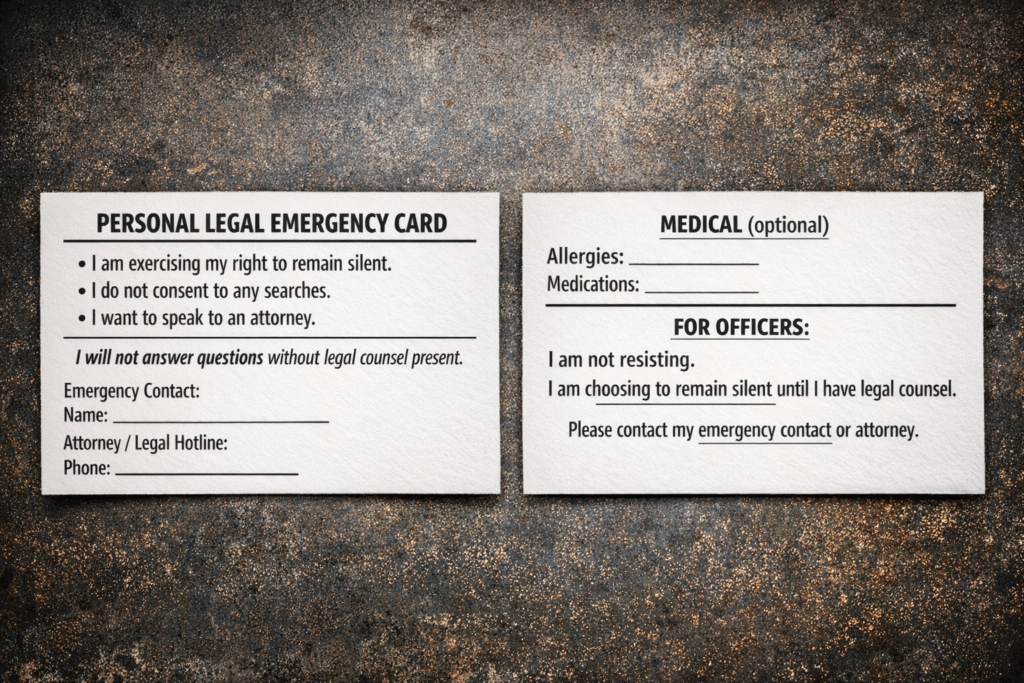
Example
A protest dispersal order is issued and a participant is detained. Instead of answering questions about where they came from or who organized the event, they hand the officer the card and remain silent. Officers must stop casual questioning and move into formal procedure. The emergency contact calls a legal hotline, and a legal observer is notified. The situation shifts from interrogation to documentation.
Without preparation, many people unintentionally provide statements that justify charges such as obstruction or false statements.
Reading List and Resources
- ACLU “Know Your Rights During Police Encounters” — https://www.aclu.org/know-your-rights/stopped-by-police
- National Lawyers Guild Protester Guide — https://www.nlg.org/resource/know-your-rights/
- Immigrant Legal Resource Center Red Cards — https://www.ilrc.org/red-cards-tarjetas-rojas
- Electronic Frontier Foundation Surveillance Self-Defense — https://ssd.eff.org
- Report arrests and request support — https://www.jailhouselaw.org
Conclusion
Preparation replaces panic. A Personal Legal Emergency Card does not make you confrontational — it makes you clear. You are not refusing cooperation; you are asserting legal boundaries. You do not need legal training, quick thinking, or bravery in the moment. You only need one action: hand over the card and stop talking.
Calm behavior under pressure protects you and protects your community.