
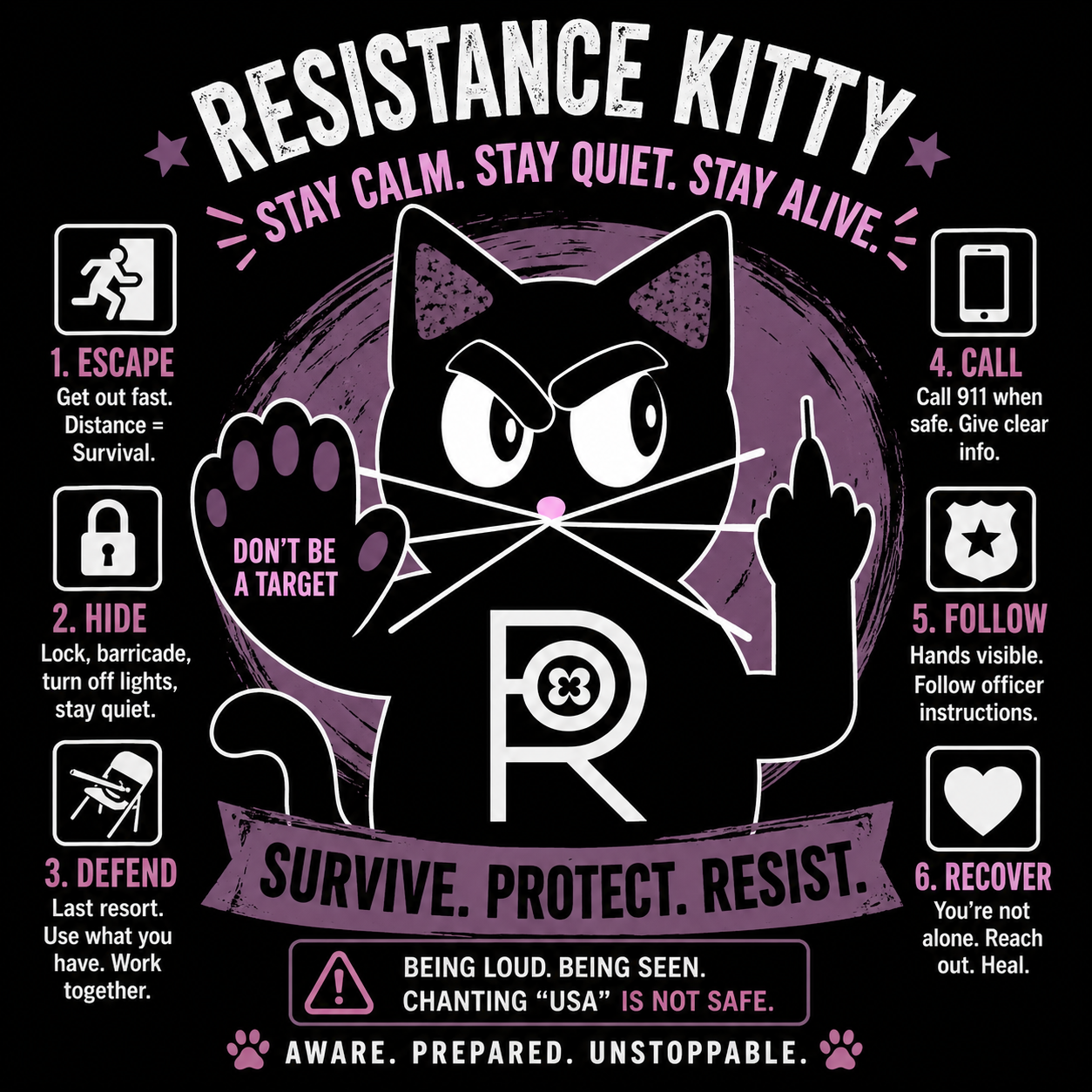

Resistance Survival Guide #257
If there is one thing recent events keep proving, it is this. Chaos does not wait for a convenient location. It can happen at a dinner, a protest, a workplace, or a public event where people feel safe. That is exactly why you need a plan before anything happens. When people panic, they hesitate. When you already know what to do, you move.
This guide is about staying alive. Not being brave. Not being loud. Not being seen. Alive.
Why This Matters
During a shooting, confusion spreads faster than information. People look to each other for cues. Some freeze. Some start recording. Some do the worst possible thing and draw attention to themselves by yelling or chanting. That includes chanting USA or anything else. Noise and visibility are not safe choices when someone is actively looking for targets.
Survival depends on reducing your visibility and acting faster than the crowd.
What This Is
This is a grounded survival framework based on real emergency response guidance and incident patterns. The priorities are simple and proven:
- escape if possible
- hide if escape is not possible
- defend yourself only as a last resort
You are not trying to understand the situation. You are trying to survive it.
Step by Step Guide
Step 1: Recognize The Threat Immediately
Gunfire often does not register right away. It can sound like popping, banging, or objects falling. In multiple real incidents, people lost critical seconds trying to confirm what they were hearing. If something feels wrong, treat it as real immediately. Do not wait for confirmation. Your instinct to pause is your biggest risk in that moment.
Step 2: Escape Fast And Without Hesitation
Your first move should always be to get out. Distance is your best protection.
Move quickly toward the nearest exit. Leave your belongings behind. Encourage others to come with you, but do not stop if they hesitate. Every second matters.
Stay low if possible and use solid objects as cover while moving. Walls, large furniture, and structural barriers are safer than open space. Avoid elevators. Once you reach safety, keep your hands visible so you are not mistaken for a threat.
Do not stop to film. Do not stop to figure things out. Movement is survival.
Step 3: Hide If You Cannot Escape
If you cannot get out, your goal is to disappear.
Find a room that can be locked or barricaded. Block the door with heavy furniture. Turn off the lights and silence your phone completely, including vibration.
Position yourself behind objects that can slow or stop bullets if possible. Thick desks, cabinets, or concrete barriers are better than thin walls.
Stay quiet. Stay still. Do not whisper. Do not call out. Drawing attention to yourself is dangerous.
Step 4: Prepare To Defend Yourself If Necessary
If a shooter reaches you and there is no escape, you must act decisively.
Use whatever is available as a weapon. Fire extinguishers, chairs, bags, or tools can be used to disrupt and disable. If others are with you, act together. Coordination increases your chances.
This is not about fighting fair. It is about surviving.
Step 5: Call For Help When It Is Safe
Once you are in a secure location, contact emergency services.
Provide clear and simple information. Your location. What you heard or saw. Any description you can give. Even partial information helps responders.
Do not assume someone else has called. Multiple calls improve response accuracy.
Step 6: When Law Enforcement Arrives
Law enforcement will focus on stopping the threat first.
Keep your hands visible at all times. Do not run toward officers. Do not make sudden movements. Follow instructions immediately and calmly.
This is not the moment to explain everything. It is the moment to be clearly non threatening.
Step 7: After You Are Safe
Once you are physically safe, your body will still be in survival mode.
Sit down. Drink water. Contact someone you trust. Avoid immediately flooding your brain with news or social media. Your nervous system needs time to settle.
If you continue to feel overwhelmed, reach out to support resources like the National Alliance on Mental Illness, which provides guidance on trauma and crisis recovery.
Example Scenario
You are at a crowded indoor event when loud popping sounds trigger confusion. Instead of looking around, you immediately move toward an exit you noticed earlier. Others hesitate, but you keep going. You exit the building, put distance between yourself and the scene, then call emergency services and check in with others.
That early decision to move is what keeps you safe.
Required Reading
- Active Shooter Preparedness by Ready.gov
- Stop the Bleed Emergency Training
- Post Traumatic Stress Information from National Institute of Mental Health
Source List
- Ready.gov Active Shooter Guidance
- Department of Homeland Security Active Shooter Response
- National Institute of Mental Health PTSD Resources
- Stop the Bleed Official Training Program
Conclusion
You do not rise to the moment in a crisis. You fall to your level of preparation. Now you have a plan. That means you move faster. You stay quieter. You make better decisions under pressure. Stay aware. Know your exits. And remember this clearly being loud, visible, or drawing attention like chanting is not survival being calm, fast, and hard to find is. Prepared people give themselves a real chance to walk away.
Kitty’s Resistance Projects
- Resistance Directory:https://resistancedirectory.com/
- EpsteinWiki:Epsteinwiki.com
Support Resistance Kitty’s Work
- Kitty Merch:https://rgearshop.com/
- Support Kitty:https://buymeacoffee.com/resistancekitty


