


Authoritarian Playbook on Repeat: Courts Push Back While the Trump Machine Keeps Testing the Limits
Another day in America’s ongoing constitutional stress test. Courts are increasingly forced to step in as the Trump political machine continues to probe the boundaries of executive power, election rules, immigration enforcement, and federal authority. While some judges are slowing down the most extreme policies, the broader strategy remains clear: overwhelm institutions, normalize chaos, and see what sticks. The good news? Resistance is not theoretical anymore — it’s happening in courtrooms, city councils, ballot initiatives, and grassroots organizing across the country. The question now isn’t whether people will resist. The question is whether enough people will act fast enough to protect democracy before the next power grab becomes permanent.
Pedo von Schitzenpantz aka The Tang Dictator
“Trump Is a Russian Asset?” The Question That Refuses to Go Away
In a fiery Substack essay, writer E. Henry Schoenberger revisits one of the most controversial questions hanging over modern American politics: whether Donald Trump has acted in ways that benefit Russian interests—and why the issue still hasn’t been fully resolved in the public conversation. The piece draws on years of reporting and intelligence findings surrounding Russian interference in the 2016 U.S. election, including investigations by U.S. intelligence agencies and Congress that concluded Russia conducted a sweeping campaign to influence the election and damage Hillary Clinton’s candidacy. Schoenberger argues that Trump’s repeated praise of Vladimir Putin, policy positions that critics say weakened NATO and Western alliances, and the long-running web of contacts between Trump associates and Russian figures have kept the debate alive long after the initial investigations ended. The result is a political mystery that continues to divide the country—because when the evidence trail runs through intelligence reports, foreign influence operations, and years of unanswered questions, people tend to keep asking whether the story is really finished.
Courts Push Back: Subpoenas Quashed, Culture-War Laws Blocked, and the Judiciary Reminds Washington Who Writes the Rules
The latest legal roundup from Capitol Hill Reader highlights a string of recent federal court decisions that quietly—but significantly—push back on government overreach. In one major ruling, a federal judge threw out Justice Department subpoenas targeting Federal Reserve Chair Jerome Powell, finding prosecutors had produced virtually no evidence of a crime and suggesting the investigation appeared designed to pressure the central bank politically. The digest also walks readers through appellate decisions on immigration law and free-speech challenges, including a Ninth Circuit ruling that blocked enforcement of a Montana law restricting drag performances because it likely violated the First Amendment. The takeaway is classic Washington irony: while politicians keep signing executive orders and launching investigations, the courts keep stepping in to remind everyone that constitutional limits still exist—no matter how loudly the political branches try to pretend otherwise.
Department of War Crimes
War With Iran Intensifies: Missiles, Drones, and the Global Oil Lifeline in the Crosshairs
The latest Iran Update Evening Special Report (March 15, 2026) from the Critical Threats Project and the Institute for the Study of War paints a picture of a rapidly escalating regional conflict as the United States and Israel continue coordinated strikes on Iranian military infrastructure while Tehran pushes back with missiles, drones, and proxy operations across the Middle East. Analysts say Iran is pursuing a multi-front strategy designed to raise the cost of the war—targeting U.S. and allied positions, threatening shipping in the Persian Gulf, and using regional militias to expand the battlefield. At the center of the crisis is the Strait of Hormuz, one of the world’s most critical energy chokepoints, where threats to shipping could disrupt roughly 20 percent of global oil transit and send shockwaves through the global economy. The report suggests the military campaign may be degrading parts of Iran’s missile and naval capabilities, but it also warns that Tehran’s ability to retaliate through drones, proxy groups, cyber operations, and attacks on energy infrastructure means the conflict is far from contained—because when a war touches the global oil supply, it stops being a regional problem and starts becoming everyone’s problem.
Midterms
Florida Redistricting Drama: Even Republicans Are Warning Their Party Not to Get Greedy
A new political roundup from The Downballot highlights growing tensions inside Florida’s Republican leadership as lawmakers debate whether to redraw congressional districts ahead of the 2026 elections. Rep. Kat Cammack is reportedly cautioning fellow Republicans not to push for an aggressive gerrymander that could backfire politically, warning that attempts to flip as many as five Democratic seats could actually put GOP districts at risk. Behind the scenes, the fight is tangled up with broader dysfunction in Tallahassee, where infighting between Gov. Ron DeSantis, the House speaker, and Senate leadership has already stalled the state budget and could complicate plans for a special redistricting session. The dispute underscores just how high the stakes are heading into the 2026 election cycle, when Florida voters will choose a new governor and fill multiple statewide offices while both parties jockey to shape congressional maps that could influence control of the U.S. House.
The Resistance
Activism Before Coffee: Why Early-Morning Resistance Might Be the Secret Weapon of Grassroots Organizing
The latest post from the activist newsletter “Don’t Mourn, Organize! Eastern Massachusetts” argues that the most effective resistance often starts earlier than people think—sometimes literally at sunrise. The piece highlights how dedicated activists are using early-morning hours to plan strategy, coordinate outreach, and show up for protests, phone banks, and organizing work before the workday even begins. It’s part of a broader grassroots strategy promoted by organizers who believe sustained political change requires consistency, community, and a willingness to build habits around activism rather than treating it as a one-off event. The newsletter itself is produced by a group of Boston-area organizers who review political action alerts and recommend what they believe are the most effective ways for citizens to push back against policies and organize locally. And yes—the message is pretty clear: democracy may not be a morning person, but if you want to defend it, you might have to be.
War, Oil Shocks, and the Nuclear Pivot: How the Iran Conflict Could Reshape the Global Energy Future
A new analysis from The Bulletin of the Atomic Scientists argues that the escalating conflict with Iran may unintentionally accelerate one of the biggest shifts in global energy policy: the move away from fossil fuels and toward nuclear power. As war disrupts oil markets and exposes the fragility of global energy supply chains—especially choke points like the Strait of Hormuz, which carries roughly 20% of the world’s seaborne oil—the shock could push governments to diversify energy sources much faster than climate policy alone ever did. Ironically, the effort to dismantle Iran’s nuclear program may actually spur wider adoption of nuclear energy worldwide as countries chase energy security and independence. The result? A messy geopolitical puzzle where energy security, nuclear technology, and global power competition collide—because nothing motivates governments to rethink energy policy quite like the sudden realization that oil supply can disappear overnight.
American Gestapo
Leaked DHS Documents Reveal a Hardline Border Patrol Strategy Spreading Nationwide
A new investigation by journalist Daniel Boguslaw based on leaked Department of Homeland Security documents suggests the U.S. Border Patrol has been quietly reshaped by a more aggressive enforcement strategy tied to controversial commander Gregory Bovino. Internal guidance reportedly circulated within the agency describes tactics for forcibly removing suspects from vehicles—such as breaking car windows—while carefully documenting incidents to protect agents from legal liability. The documents and accounts from DHS employees paint a picture of an enforcement culture spreading beyond the southern border into U.S. cities, where federal immigration operations have become increasingly militarized and politically contentious. Critics say the approach raises serious civil-rights concerns, particularly after several high-profile incidents involving civilian deaths and lawsuits tied to aggressive immigration raids. The revelations are likely to intensify the ongoing national debate over immigration enforcement, federal policing powers, and whether tactics developed for border operations are now being exported deep into the American interior.
From Protest to “Terrorism”: The ICE Trial That Could Redefine Activism in America
A new investigation from The Intercept examines the explosive legal fallout from the Prairieland ICE detention center case in Texas, where a federal jury convicted several anti-ICE protesters on terrorism-related charges tied to a July 4, 2025 protest outside the facility. Prosecutors argued the group acted as part of an “antifa cell” that used fireworks as a diversion during an attack that wounded a police officer, while defense attorneys insisted most defendants believed they were attending a protest and had no role in the shooting. Critics say the case represents a dramatic expansion of federal terrorism law into protest activity, warning it could create a precedent where attending a demonstration that turns chaotic might expose participants to terrorism charges. The verdict has sparked a national debate over protest rights, government power, and whether the line between political dissent and criminal conspiracy is being redrawn in real time—because once the word “terrorism” enters the courtroom, the rules of the game change fast.
Chamber of Whores
The SAVE Act Fight: Election Security—or a New Barrier to the Ballot Box?
A new analysis from The Preamble argues that the controversial SAVE Act election legislation may have consequences far beyond the stated goal of preventing non-citizen voting. The bill would require people registering to vote to provide proof of U.S. citizenship—often a birth certificate or passport—but critics warn that strict name-matching rules could create unexpected hurdles for millions of Americans whose legal names have changed. In particular, married women who adopted a spouse’s last name may have to obtain additional documents like marriage certificates or notarized affidavits just to register, creating extra costs, delays, and bureaucratic obstacles that other voters wouldn’t face. The article also places the debate in a broader historical context, noting that while women secured the right to vote through the 19th Amendment, modern political rhetoric around voting rights and “household voting” has revived old arguments about women’s political participation. The result is a growing national fight over election security versus voter access—because when voting laws start intersecting with identity documents, marriage records, and name changes, the line between “administration” and “disenfranchisement” can get blurry very quickly.
The Epstein Class
More Epstein Files, More Questions: The Paper Trail of Power Isn’t Going Quiet
Today’s update on EpsteinWiki News Update – March 16, 2026 digs deeper into the expanding fallout from the ongoing release of the so-called Epstein files, the massive trove of investigative records tied to financier and convicted sex offender Jeffrey Epstein. These documents—millions of pages of emails, flight logs, interviews, and financial records—continue to ripple through politics, media, and elite social circles as researchers, journalists, and the public comb through the evidence for connections and accountability. The files stem from multiple criminal investigations into Epstein’s trafficking network and have become one of the largest document releases tied to a modern criminal scandal. And while officials insist the material released so far represents the available record, critics argue the story is far from finished—because when the powerful spend decades leaving a paper trail, eventually someone starts reading the fine print.
Featured Resisters
- EpsteinFury.net EpsteinFury.net is an independent online tracker that monitors the financial, military, and geopolitical impacts of the U.S. military operation referred to on the site as “Operation Epstein Fury.” The platform presents a live dashboard designed to track the real-time economic costs of the conflict, military deployments, casualty estimates, and broader global market impacts linked to the operation.
- Roll Call Roll Call is a Washington, D.C.based political news publication that focuses on reporting about the United States Congress, federal legislation, and national political developments. Founded in 1955 by former congressional press secretary Sid Yudain, the publication has long been known as the “newspaper of Capitol Hill” because of its dedicated coverage of lawmakers, congressional staff, elections, and legislative policy.
What We Are Watching Today
- President Trump and Vice President Vance Hold Signing Ceremony
- Senate Session
- House Session
- White House Press Secretary Speaks to Reporters
- Commission on Security and Cooperation in Europe (U.S. Helsinki Commission) | 10:30 AM (EDT) | Meeting Details
- House Committee on Rules | 4:00 PM Local Time | Meeting Details
- Senate Committee on Agriculture, Nutrition, and Forestry | 5:30 PM (EDT) | Meeting Details
- The United States Court of Appeals for the DC Circuit
Today’s Call to Action
1. Sign Up for a Virtual Event
- NO KINGS TRAINING & INFO FOR ATTENDING RALLY Thursday, March 26 7 – 8pm EDT
2. Volunteer with a Movement
3. Read Today’s Resistance Survival Guide
4. Send these Pre Written Letters (They make great call scripts also)
- Tell Congress: End the Cuba Embargo
- Tell Congress: Vote NO on the SAVE Act
- SHUT DOWN “ALLIGATOR ALCATRAZ” — AND EVERY CRUEL DETENTION CENTER
5. RSVP for the International March 28th No Kings Protest
Let’s Roll!
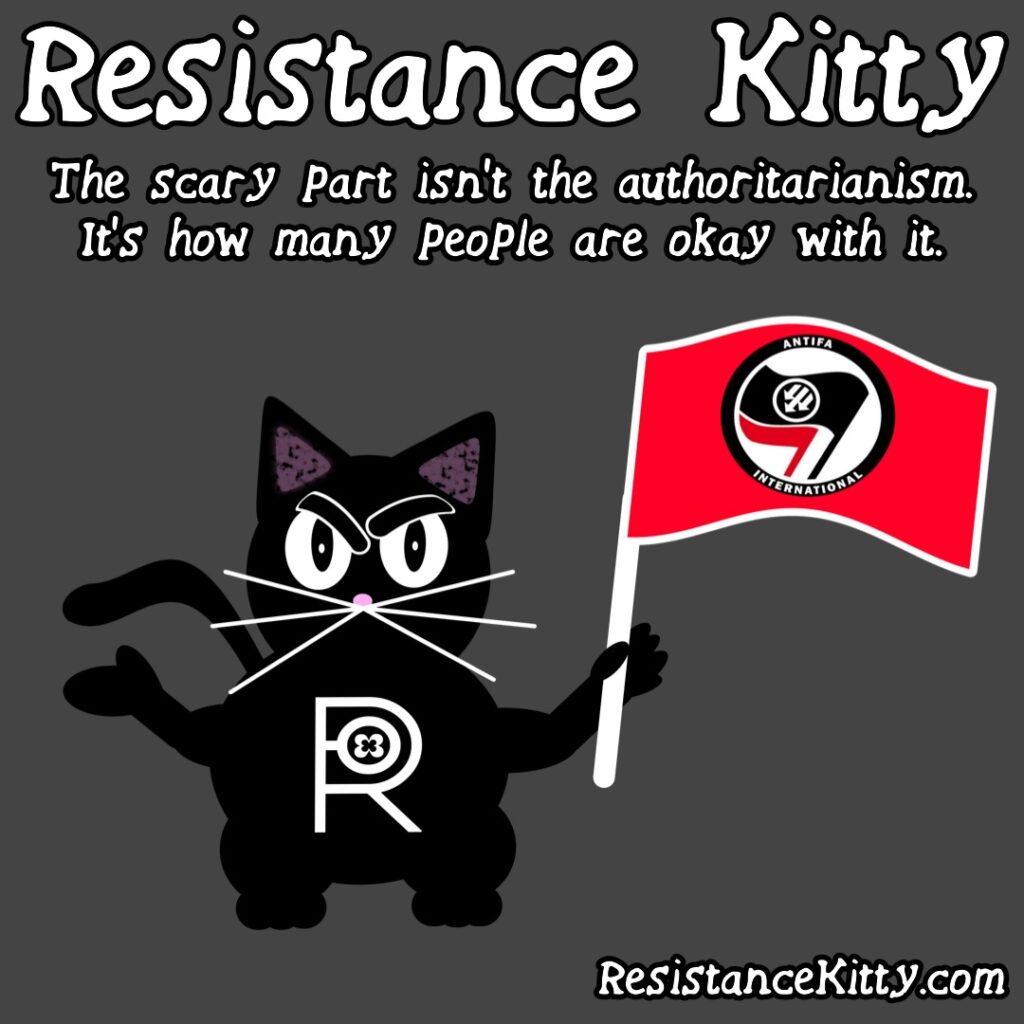
Authoritarianism rarely arrives with a drumroll and a villain speech. It creeps in through policy tweaks, emergency powers, and the steady erosion of norms. That is exactly why vigilance matters. Courts, journalists, watchdog groups, and everyday citizens are still pushing back — and those efforts are slowing some of the damage. But democratic systems only survive when people participate. Call your representatives. Support independent journalism. Show up to protests. Share verified information. Democracy isn’t self-sustaining. It survives because ordinary people refuse to let it die.
Kitty’s Resistance Projects
- Resistance Directory: https://resistancedirectory.com/
- EpsteinWiki: Epsteinwiki.com
Support Resistance Kitty’s Work
- Kitty Merch: https://tr.ee/–Pu9s-BUL
- Support Kitty: https://buymeacoffee.com/resistancekitty
