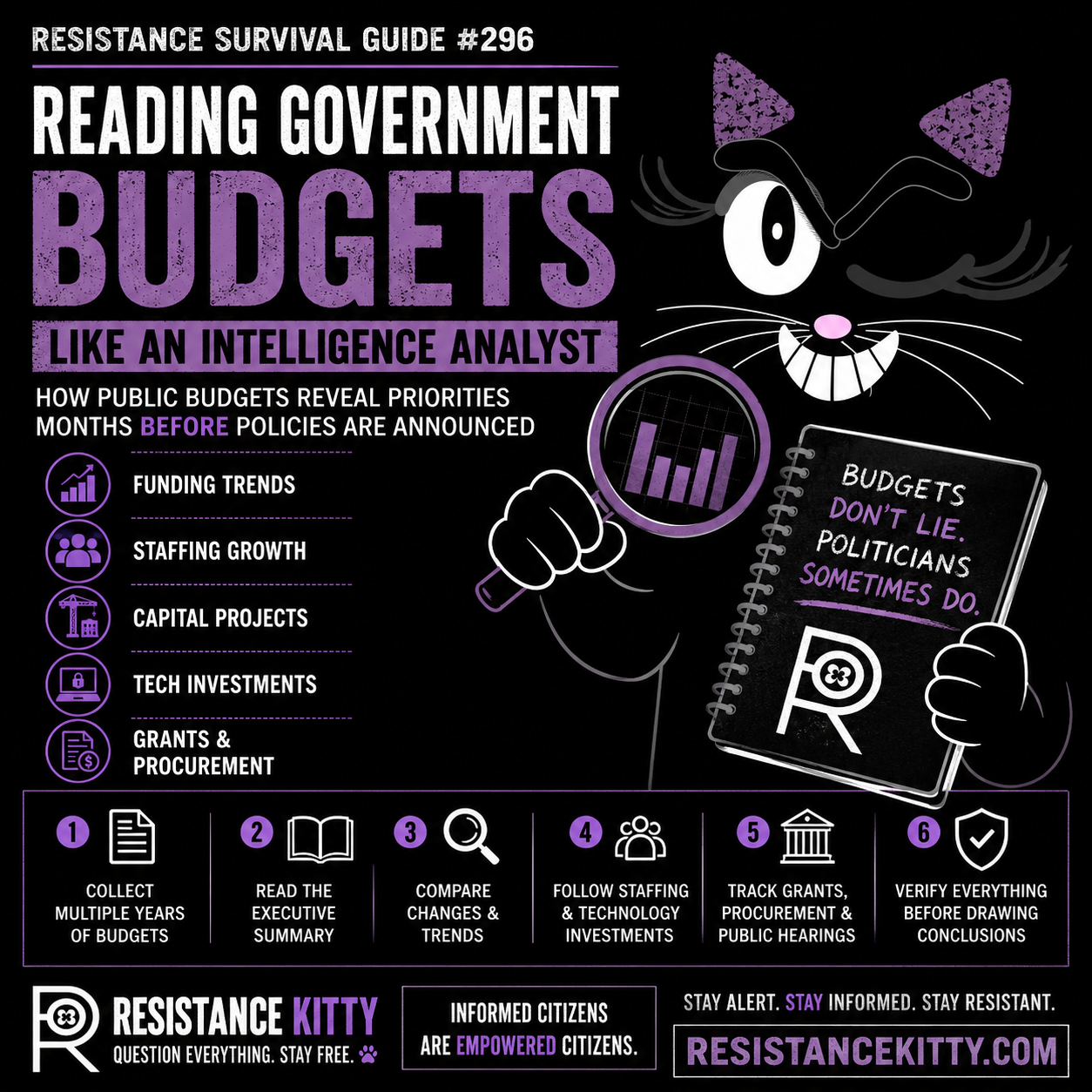

Resistance Survival Guide #296
How Public Budgets Reveal Priorities Months Before Policies Are Announced
Most people learn about government priorities after legislation is introduced, a press conference is held, or a major news story breaks. Investigators know there is a much earlier source of information that is available to everyone. Government budgets often reveal strategic priorities months before they become public policy. Every request for funding reflects a planned activity, whether that involves hiring personnel, expanding technology, building infrastructure, or launching new programs.
Learning to read public budgets like an intelligence analyst allows citizens to recognize trends before they become headlines. Rather than focusing only on total spending, successful researchers compare multiple years, identify changes, verify those observations through other public records, and build a long term understanding of how governments allocate resources. This guide explains how to do that using publicly available information and reliable independent sources.
Why Budgets Matter
A budget is more than an accounting document. It is a roadmap of future priorities. Agencies cannot hire employees, purchase equipment, construct buildings, or launch programs without first requesting funding. Those requests often become public months before implementation begins.
The budgeting process also requires agencies to explain why they need additional resources. Those written explanations provide valuable insight into future goals, organizational priorities, and planned initiatives. Resources from the Government Finance Officers Association explain how public budgets are developed and why they serve as planning documents as much as financial reports.
What Intelligence Analysts Look For
Experienced analysts rarely focus on one large number. Instead, they examine changes over time. A department that receives consistent funding increases over several years is often expanding its mission. A sudden investment in cybersecurity, emergency management, transportation, housing, or public health may indicate an emerging policy priority long before formal announcements occur.
Analysts also compare budgets with procurement notices, strategic plans, grant awards, public meeting agendas, inspector general reports, and oversight hearings. The goal is to build multiple independent lines of evidence before reaching any conclusion.
Step by Step Guide
Step 1: Collect Several Years of Budgets
Never analyze a single budget by itself. Download at least three to five years of budget documents from the same agency. Comparing multiple fiscal years allows you to identify meaningful trends instead of reacting to one time fluctuations. Local governments, school districts, counties, states, and federal agencies typically archive previous budgets on their official websites, making historical comparisons relatively straightforward.
Step 2: Read the Executive Summary First
The executive summary often contains the agency’s strategic priorities in plain language. Before examining financial tables, read how officials describe the coming fiscal year. Look for recurring themes such as modernization, infrastructure, workforce development, resilience, preparedness, technology, economic development, or public safety. These themes usually appear throughout the remainder of the budget and provide valuable context.
Step 3: Compare Funding Changes Across Departments
Rather than focusing only on total spending, compare how funding changes between departments. Significant increases may indicate new priorities while reductions can suggest shifting resources or completed initiatives. The National Association of State Budget Officers publishes comparative research that helps explain how governments organize and present budget information.
Step 4: Follow Personnel Growth
Government programs require people. When budgets request additional investigators, engineers, attorneys, technology specialists, emergency managers, or inspectors, ask why those positions are needed. Staffing increases often provide one of the earliest indicators that an agency expects expanded responsibilities during the coming years.
Step 5: Examine Capital Improvement Plans
Many governments publish Capital Improvement Plans alongside annual budgets. These documents outline construction projects, transportation improvements, utility upgrades, communications systems, and public safety facilities planned years into the future. Because infrastructure projects require lengthy planning, they frequently reveal long term priorities well before construction begins.
Step 6: Watch Technology Investments Carefully
Technology spending often signals organizational transformation. Budgets requesting investments in cybersecurity, cloud computing, digital records management, artificial intelligence, geographic information systems, emergency communications, or data analytics may indicate significant operational changes. Understanding these purchases provides valuable context for future policy developments.
Step 7: Read the Narrative Sections
Financial tables explain where money is allocated, but narrative sections explain why. Read department mission statements, performance goals, strategic objectives, and program descriptions carefully. Agencies frequently describe upcoming initiatives in these sections before those initiatives become widely discussed.
Step 8: Monitor Grant Funding
Many government initiatives begin with grant funding. Federal grants frequently support state programs, while state grants often fund county and municipal projects. Monitoring opportunities through Grants.gov helps identify emerging priorities involving transportation, education, emergency management, environmental protection, healthcare, and infrastructure before programs are fully implemented.
Step 9: Compare Budgets With Procurement Records
Budgets describe intentions while procurement records show implementation. After identifying a major investment within a budget, review purchasing opportunities through SAM.gov to determine whether agencies have begun soliciting contractors, equipment, consulting services, or technology. Comparing these two sources strengthens your understanding of how planning becomes action.
Step 10: Watch Public Budget Hearings
Budget hearings often contain discussions that never appear in written documents. Department leaders explain spending requests, elected officials ask questions, and concerns are debated in public. Watching these meetings provides valuable context that cannot always be found in the budget itself.
Step 11: Build Your Intelligence Notebook
Create a dedicated notebook for each agency you monitor. Record annual funding changes, staffing increases, major capital projects, grant awards, procurement notices, and oversight findings. Review these notes throughout the year to determine whether predicted priorities become reality. Over time, this record becomes one of your most valuable investigative tools.
Step 12: Verify Before Drawing Conclusions
Budgets provide evidence of planning rather than proof of future actions. Before reaching conclusions, compare your observations with committee agendas, strategic plans, inspector general reports, procurement notices, court filings, and official announcements. Strong investigations rely on multiple independent sources supporting the same conclusion rather than a single document.
Common Mistakes to Avoid
Many new researchers focus only on the largest spending categories while overlooking smaller changes that may represent entirely new initiatives. Others assume that increased funding automatically guarantees implementation, when budgets can change throughout the fiscal year. Another common mistake is failing to compare current budgets with previous years, making it difficult to recognize long term trends. Patience, consistency, and verification are essential when conducting budget research.
Independent Research Resources
Several nonprofit organizations regularly demonstrate how financial records can reveal important public interest stories. Investigative reporting from ProPublica frequently incorporates public budget data, procurement records, and government spending information. The journalists at The Center for Public Integrity examine public finance, ethics, and accountability through evidence based reporting. Citizens interested in obtaining supporting documents can learn more about public records requests through MuckRock. Federal oversight reports published by the Government Accountability Office and budget analyses from the Congressional Budget Office also provide valuable context for understanding government priorities.
Final Thoughts
Government budgets are among the earliest public indicators of future policy. Every staffing request, technology investment, infrastructure project, grant program, and capital improvement reflects decisions that agencies hope to implement in the coming months or years. By comparing multiple budgets, following procurement activity, monitoring grant funding, and verifying observations through independent public records, citizens can better understand how priorities evolve before they become headlines.
Reading budgets like an intelligence analyst is not about predicting the future with certainty. It is about recognizing patterns, asking informed questions, and using publicly available evidence to understand how governments allocate resources. Over time, this approach builds stronger civic awareness and supports more informed participation in local, state, and national government.
Source List
- Government Finance Officers Association
- National Association of State Budget Officers
- Congressional Budget Office
- Government Accountability Office
- Grants.gov
- SAM.gov
- ProPublica
- The Center for Public Integrity
- MuckRock