

Resistance Survival Guide #244
Skill Level: Beginner
If you think you will figure it out in the moment, you won’t. When systems get shaky, information gets messy, and people start scrambling, the difference between panic and action comes down to one thing: preparation. Building a local resource map before you need it means you already know where to go, who to call, and what options you have when things get unpredictable. This is how you stay grounded, move faster than the chaos, and make sure you and your community are not left guessing when it matters most.
Why This Matters
In a crisis, confusion wastes time and time costs safety. When systems strain or fail, people do not have the luxury of searching, scrolling, or guessing. They need to know exactly where to go for food, medical care, legal help, transportation, and safe spaces. Government guidance consistently emphasizes planning ahead because response time is everything. The official preparedness guidance from Ready.gov planning resources explains that creating a plan before disaster strikes improves coordination, reduces panic, and helps people act quickly under pressure.
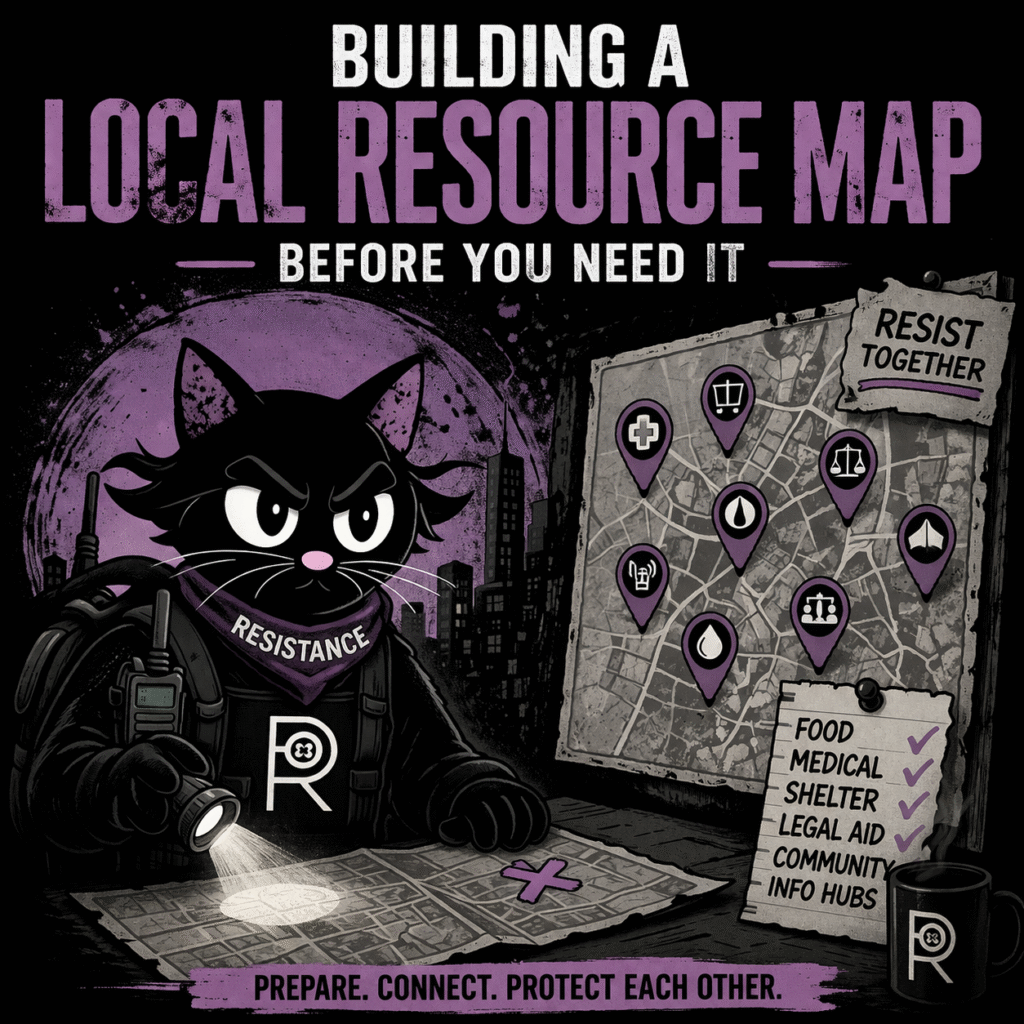
A local resource map turns chaos into clarity. Instead of relying on memory or unstable platforms, you create a living system of verified, trusted locations and services. This is especially critical for vulnerable populations, mutual aid work, and resistance communities that cannot rely on traditional systems to respond quickly or fairly. The goal is simple. You remove guesswork so you can move.
What This Is
A local resource map is a curated, organized list of real world support systems in your area, built before you need them. It includes essentials like hospitals, urgent care centers, pharmacies, food banks, shelters, legal aid, and community organizations. It also includes nontraditional but critical resources like mutual aid groups, independent journalists, and local organizers.
You are not just collecting addresses. You are building a decision making tool. The CISA preparedness resources emphasize situational awareness and planning ahead, and that principle applies here. A resource map gives you options, and options give you control when everything else feels unstable.
Step by Step Instructions
Step 1: Start With Life Critical Resources First
Begin by identifying the resources you would need in the first 24 to 72 hours of a disruption. Focus on hospitals, urgent care centers, pharmacies, and emergency shelters. Use reliable directories like HRSA Find a Health Center to locate nearby clinics and American Red Cross shelter locator to identify emergency shelter options.
Write down the name, address, phone number, and hours of operation for each location. Then add one more detail most people forget. Note whether the location is accessible by walking, public transit, or car. In a real disruption, transportation changes everything.
Step 2: Add Food, Water, and Daily Survival Resources
Next, map out where you can reliably access food and basic supplies. Include grocery stores, food banks, community kitchens, and mutual aid distribution points. Use tools like Feeding America food bank locator to identify structured food support systems.
Then layer in smaller, community driven options. Local churches, neighborhood groups, and grassroots organizations often respond faster than large systems. These are not always easy to find through search engines, so ask around and verify them directly. This is where your map starts becoming stronger than anything you can Google in a panic.
Step 3: Identify Legal, Medical, and Crisis Support Services
Now build your support layer for when things go wrong. Add legal aid organizations, crisis hotlines, domestic violence shelters, and mental health services. The Legal Services Corporation helps connect people with civil legal assistance, and the 988 Lifeline provides immediate mental health crisis support across the United States.
Include at least one option in each category. If possible, include two. Redundancy matters because services can become overwhelmed quickly.
Step 4: Map Communication and Information Hubs
Identify where reliable information flows in your community. This includes local independent media, community bulletin boards, libraries, and emergency information centers. Libraries are especially valuable because they often provide internet access, charging stations, and community information. The Institute of Museum and Library Services highlights the role libraries play as community resilience hubs during emergencies.
Also include your trusted digital sources, but write them down in a way that does not depend on one device. If your phone dies or your account is locked, you still need access to that information.
Step 5: Organize Your Map Into a Simple, Usable Format
Now take everything you gathered and make it usable. Create a clean document organized by category such as medical, food, shelter, legal, and communication. Keep it simple enough that someone else could understand it quickly.
Store it in three places. First, save it digitally. Second, print a physical copy. Third, share it with at least one trusted person. The Ready.gov emergency kit guidance recommends keeping important documents in both digital and physical formats because access can fail in different ways.
Step 6: Verify and Update Regularly
A resource map is not a one time project. It is a living system. Once a month, check that locations are still open, phone numbers still work, and services are still available. If you can, call or visit at least one resource periodically to confirm it is active.
This step separates a useful plan from a false sense of security. Outdated information is dangerous because it wastes time when time matters most.
Example
Imagine a sudden disruption where supply chains are strained and services are limited. Instead of searching online while everyone else is doing the same thing, you open your map. You already know the closest clinic, the nearest food bank, and the backup grocery store that stays open late. You know which legal aid office to call if something escalates and which community group is distributing supplies. While others are reacting, you are moving. That is the difference preparation creates.
Conclusion
A local resource map is one of the simplest and most powerful tools you can build. It turns uncertainty into action and replaces panic with direction. You are not waiting for systems to work. You are preparing for the moment they do not. Build it once. Maintain it regularly. Share it carefully. And when things get unstable, you will not be guessing where to go. You will already know.
Sources
- Ready.gov planning resources
- Ready.gov emergency kit guidance
- CISA preparedness resources
- HRSA Find a Health Center
- American Red Cross shelter locator
- Feeding America food bank locator
- Legal Services Corporation overview
- 988 Suicide and Crisis Lifeline
- Institute of Museum and Library Services
Kitty’s Resistance Projects
- Resistance Directory: https://resistancedirectory.com/
- EpsteinWiki: Epsteinwiki.com
Support Resistance Kitty’s Work
- Kitty Merch: https://rgearshop.com/
- Support Kitty: https://buymeacoffee.com/resistancekitty

